Saturday, 27 July 2013

cnc milling programing


What is Predator CNC Editor?

With an editor designed just for CNC programs vs. plain text. CNC Editor has lots of powerful CNC specific features yet remains very easy to use. For a minute imagine an office using Notepad instead of Word for word processing. This is how most shops are setup. Editing on the CNC controls can be even more time consuming. Predator CNC Editor is intelligent and knows G code. You can even verify your CNC programs with 3D solid based verification.
Predator G-Code Editor

Predator CNC Editor Software System Requirements

Support for the following minimum computer hardware is required for v7:
  • Pentium 4, AMD Athlon or newer CPU
  • 40 GB or larger hard drive
  • 512 MB or more RAM
  • Mouse
  • USB Port
  • Serial Ports – for DNC communication
NOTE: A nVidia, AMD or 3DLabs based graphics card is highly recommended for Predator Virtual CNC. Like most CAD/CAM systems Predator Virtual CNC will often require high end PC components to support large and complex 3D simulations for optimum performance

Wednesday, 24 July 2013

Drilling Machine

Drilling Machine

May 17, 2011
VERTICAL DRILL MACHINE

OBJECTIVE:

Drilling is a process of machining with a rotary cutting motion, in which the tool only   allows a feed movement in the direction of the axis of rotation. Drill includes various production processes such as counter boring and reaming. Drilling purpose is to make hole from the solid by using twist drill.

Drilling Details

Drilling is the operation of producing circular hole in the work-piece by using a rotating cutter called DRILL.
  • § The machine used for drilling is called drilling machine.
  • § The drilling operation can also be accomplished in lathe, in which the drill is held in tailstock and the work is held by the chuck.
  • § The most common drill used is the twist drill.
Drilling Machine
• It is the simplest and accurate machine used in production shop.
• The work piece is held stationary ie. Clamped in position and the drill rotates to make a hole.
Types
1) Based on construction:
Portable,
Sensitive,
Radial,
up-right,
Gang,
Multi-spindle
2) Based on Feed:
Hand driven
Power driven
Components of drilling machine
Spindle
The spindle holds the drill or cutting tools and revolves in a fixed position in a sleeve.
Sleeve
The sleeve or quill assembly does not revolve but may slide in its bearing in a direction parallel to its axis. When the sleeve carrying the spindle with a cutting tool is lowered, the cutting tool is fed into the work: and when it’s moved upward, the cutting tool is withdrawn from the work. Feed pressure applied to the sleeve by hand or power causes the revolving drill to cut its way into the work a fraction of an mm per revolution.
Column
The column is cylindrical in shape and built rugged and solid. The column supports the head and the sleeve or quill assembly.
Head
The head of the drilling machine is composed of the sleeve, a spindle, an electric motor and feed mechanism. The head is bolted to the column.
Worktable
The worktable is supported on an arm mounted to the column. The worktable can be adjusted vertically to accommodate different heights of work or it can be swung completely out of the way. It may be tilted up to 90 degree in either direction, to allow long pieces to be end or angle drilled.
Base
The base of the drilling machine supports the entire machine and when bolted to the floor, provides for vibration-free operation and best machining accuracy. The top of the base is similar to the worktable and may be equipped with t- slot for mounting work too larger for the table.
Hand Feed
The hand- feed drilling machines are the simplest and most common type of drilling machines in use today. These are light duty machine that are operated by the operator, using a feed handled, so that the operator is able to “feel” the action of the cutting tool as it cuts through the work piece. These drilling machines can be bench or floor mounted.
Power feed
The power feed drilling machine are usually larger and heavier than the hand feed ones they are equipped with the ability to feed the cutting tool in to the work automatically, at preset depth of cut per revolution of the spindle these machines are used in maintenance for medium duty work or the work that uses large drills that require power feed larger work pieces are usually clamped directly to the table or base using t –bolts and clamps by a small work places are held in a vise. A depth –stop mechanism is located on the head, near the spindle, to aid in drilling to a precise depth.
Sensitive or Bench Drilling Machine
• This type of drill machine is used for very light works. Fig.1 illustrates the sketch of sensitive drilling machine.
• The vertical column carries a swiveling table the height of which can be adjusted according to the work piece height.
• The table can also be swung to any desired position.
• At the top of the column there are two pulleys connected by a belt, one pulley is mounted on the motor shaft and other on the machine spindle.
• Vertical movement to the spindle is given by the feed handle by the operator.
• Operator senses the cutting action so sensitive drilling machine.
• Drill holes from 1.5 to 15mm
Fig.1. Sensitive Drilling Machine
Up-Right Drilling Machine
• These are medium heavy duty machines.
• It specifically differs from sensitive drill in its weight, rigidity, application of power feed and wider range of spindle speed. Fig.2 shows the line sketch of up-right drilling machine.
• This machine usually has a gear driven mechanism for different spindle speed and an automatic or power feed device.
• Table can move vertically and radially.
• Drill holes up to 50mm
Fig.2 Up-Right Drilling Machine
Radial Drilling Machine
• It the largest and most versatile used for drilling medium to large and heavy work pieces.
• Radial drilling machine belong to power feed type.
• The column and radial drilling machine supports the radial arm, drill head and motor. Fig.3 shows the line sketch of radial drilling machine.
Fig. 3 Radial Drilling Machine
• The radial arm slides up and down on the column with the help of elevating screw provided on the side of the column, which is driven by a motor.
• The drill head is mounted on the radial arm and moves on the guide ways provided the radial arm can also be swiveled around the column.
• The drill head is equipped with a separate motor to drive the spindle, which carries the drill bit. A drill head may be moved on the arm manually or by power.
• Feed can be either manual or automatic with reversal mechanism.
Drill Materials
The two most common types are
1. HSS drill
- Low cost
2. Carbide- tipped drills
– high production and in CNC machines
Other types are
Solid Carbide drill, TiN coated drills, carbide coated masonry drills, parabolic drills, split point drill. Fig.4 shows various types of drills
Fig. 4 Various types of drill
Drill fixed to the spindle
Fig. 5 Drill fixed to a spindle
Tool Nomenclature
Fig. 6 Nomenclature of twist drill
Tool holding devices
Fig.7 and Fig.8 shows the different work holding and drill drift device. The different methods used for holding drill in a drill spindle are
• By directly fitting in the spindle hole.
• By using drill sleeve
• By using drill socket
• By using drill chuck
Drilling operations
Operations that can be performed in a drilling machine are
Ø Drilling
Ø Reaming
Ø Boring
Ø Counter boring
Ø Countersinking
Ø Tapping
Drilling:
It is an operation by which holes are produced in solid metal by means of revolving tool called ‘Drill’. Fig. 9 shows the various operations on drilling machine.

NEW SHAPER MACHINE

NEW SHAPER MACHINE

May 18, 2011

OBJECTIVE:

A shaping machine is used to machine surfaces. It can cut curves, angles and many other shapes. It is a popular machine in a workshop because its movement is very simple although it can produce a variety of work. Shaping machines come in a range of sizes but the most common size is seen below.
The main parts are indicated below:
The tool feed handle can be turned to slowly feed the cutting tool into the material as the ‘ram’ moves forwards and backwards. The strong machine vice holds the material securely. A small vice would not be suitable as the work could quite easily be pulled out of position and be damaged. The vice rests on a steel table which can be adjusted so that it ca be moved up and down and then locked in position. Pulling back on the clutch handle starts the ‘ram’ moving forwards and backwards.
High-Speed-SHAPER MODEL NO-MX5068-

PRODUCT DESCIRIPTION

High Speed Router MX5068 Since the establishment of our company, we have won the most business through our excellent products, honest operation and fist-rate service.
Nowadays, we are developing the international market actively. Our products sales to Africa, Europe Latin America and weur have made great achievement.

Broaching Machine


Broaching Machine

May 17, 2011

OBJECTIVE:

In broaching machine a rod-shaped tool (broach) is drawn through a hole in the work piece to make internal splines and gears called internal broaching. While across the surface of the work piece called external broaching.
Broaching Machine

Terms used for broaches:

The shank servers to fix the broach in the slide block of the machine.The pilot must fit in the pre-machined slot of the work piece with a tight clearance fit and guide the broach when cutting.The cutting body contains rows of roughing and finishing edges, the depth of cut being lower for the finishing row.The sizing row has no stepped teeth and does not cut. Its four to six teeth go over to the cutting body when the broach is sharpened. The end of the work piece has another pilot so that the broach remains steady in the finished opening at the end of the broaching operation.

Tuesday, 11 June 2013

Types of Denison pumps repaired


Types of Denison pumps repaired:

Types of Denison pumps repaired:


Types of Denison pumps repaired:


Types of Denison pumps repaired:


Monday, 10 June 2013

Types of Denison pumps repaired

Types of Denison pumps repaired:


3DO2 3DO3 3DO6 4DO1 A3D10 A3DO3 A3DO6 BBT-O7O7
M11H M11V M14G M14H M14V M1C M1D M1F07
M2F07 M46 M46H M46V M4C M4D M4E M6G
M6H M6V M7G M7H M7V MF07YQ MFO7 MFO8
MFO9 P05 P07 P080 P09 P11 P110 P11P
P11S P11V P12 P14 P140 P14P P14S P14V
P16 P16 P1FO7 P1V07 P200 P24 P24P P24S
P260 P2F07 P30S P3F07 P3V07 P46P P46V P6D
P6P P6S P6V P6W P7D P7P P7S P7V
P7W P8W PF PF06 PF07 PF08 PF09 PV06
PV07 PV08 PV09 PV10 PV15 PV20 PV29 PV6
R4U R4V R5U R5V T6C T6CC T6CR T6D
T6DC T6DCC T6DR T6E T6EC T6ED T6ER TMB
VVO1              

Laser beam cutting

Laser beam cutting

Laser cutting uses a high powered laser to cut through sheet metal. A series of mirrors and lenses direct and focus a high-energy beam of light onto the surface of the sheet where it is to be cut. When the beam strikes the surface, the energy of the beam melts and vaporizes the metal underneath. Any remaining molten metal or vapor is blown away from the cut by a stream of gas. The position of the laser beam relative to the sheet is precisely controlled to allow the laser to follow the desired cutting path.

This process is carried out on laser cutting machines that consist of a power supply, laser system, mirrors, focusing lens, nozzle, pressurized gas, and a workpiece table. The laser most commonly used for sheet metal cutting is a CO2 based laser with approximately 1000-2000 watts of power. However, Nd and Nd-YAG lasers are sometimes used for very high power applications. The laser beam is directed by a series of mirrors and through the "cutting head" which contains a lens and nozzle to focus the beam onto the cutting location. The beam diameter at the cutting surface is typically around 0.008 inches. In some machines, the cutting head is able to move in the X-Y plane over the workpiece which is clamped to a stationary table below. In other laser cutting machines, the cutting head remains stationary, while the table moves underneath it. Both systems allow the laser beam to cut out any 2D shape in the workpiece. As mentioned above, pressurized gas is also used in the process to blow away the molten metal and vapor as the cut is formed. This assist gas, typically oxygen or nitrogen, feeds into the cutting head and is blown out the same nozzle as the laser beam.

Laser cutting can be preformed on sheet metals that are both ferrous and non-ferrous. Materials with low reflectivity and conductivity allow the laser beam to be most effective - carbon steel, stainless steel, and titanium are most common. Metals that reflect light and conduct heat, such as aluminum and copper alloys, can still be cut but require a higher power laser. Laser cutting can also be used beyond sheet metal applications, to cut plastics, ceramics, stone, wood, etc.

As previously mentioned, laser cutting can be used to cut nearly any 2D shape. However, the most common use is cutting an external profile or complex features. Simple internal features, such as holes or slots are usually punched out using other sheet metal processes. But highly complex shapes and outer part boundaries are well suited for laser cutting. The fact that laser cutting does not require any physical contact with the material offers many benefits to the quality of the cuts. First, minimal burrs are formed, creating a smooth edge that may not require any finishing. Secondly, no tool contact means only minimal distortion of the sheet will occur. Also, only a small amount of heat distortion is present in the narrow zone affected by the laser beam. Lastly, no contaminates will be embedded into the material during cutting. Although not a quality issue, it is worth noting that the lack of physical tool wear will reduce costs and make laser cutting cost effective for low volume production.

Capabilities
  • Sheet thickness: 0.02-0.50 in.
  • Cutting speed: 30-500 IPM (1000 IPM feasible)
  • Kerf width: 0.006-0.016 in. (0.004 in. feasible)
  • Tolerance: ±0.005 in. (±0.001 in. feasible)
  • Surface finish: 125-250 μin

Design rules
  • Edges - Burrs are minimal, but can be further reduced by using a thinner sheet stock.
  • Corners - Rounded corners are preferred to sharp corners. Interior corners must have a minimum radius equal to the laser beam radius.
  • Holes - Minimum hole diameter should be approximately 20% of sheet thickness, down to 0.010 inches. Laser-cut holes will have a slight natural taper.
  • Multiple sheets can be cut at once to reduce cost

Drill Size Chart


Drill Size Chart

The drill size chart provides a list of standard size drill bits in several measurement systems, including fractional, metric, wire gauge number, and letter. The decimal equivalents of the diameters are shown in both English and Metric units. Fractional sizes are measured in inches, while metric sizes are measured in millimeters. The wire gauge and letter systems refer to tool diameters that increase as the wire gauge decreases from #107 to #1 and then continues from A to Z. The drill size chart contains tools up to 1.5 inches in diameter, but larger tools are also commonly used.
 
Drill size Diameter (in) Diameter (mm)
#1070.00190.0483
0.05 mm0.00200.0500
#1060.00230.0584
#1050.00270.0686
#1040.00310.0787
#1030.00350.0889
#1020.00390.0991
0.1 mm0.00390.1000
#1010.00430.1092
#1000.00470.1194
#990.00510.1295
#980.00550.1397
#970.00590.1499
#960.00630.1600
#950.00670.1702
#940.00710.1803
#930.00750.1905
0.2 mm0.00790.2000
#920.00790.2007
#910.00830.2108
#900.00870.2210
#890.00910.2311
#880.00950.2413
#870.01000.2540
#860.01050.2667
#850.01100.2794
#840.01150.2921
0.3 mm0.01180.3000
#830.01200.3048
#820.01250.3175
#810.01300.3302
#800.01350.3429
#790.01450.3680
1/64 in0.01560.3969
0.4 mm0.01580.4000
#780.01600.4064
#770.01800.4572
0.5 mm0.01970.5000
#760.02000.5080
#750.02100.5334
#740.02250.5715
0.6 mm0.02360.6000
#730.02400.6096
#720.02500.6350
#710.02600.6604
0.7 mm0.02760.7000
#700.02800.7112
#690.02920.7417
#680.03100.7874
1/32 in0.03130.7938
0.8 mm0.03150.8000
#670.03200.8128
#660.03300.8382
#650.03500.8890
0.9 mm0.03540.9000
#640.03600.9144
#630.03700.9398
#620.03800.9652
#610.03900.9906
1 mm0.03941.0000
#600.04001.0160
#590.04101.0414
#580.04201.0668
#570.04301.0922
1.1 mm0.04331.1000
#560.04651.1811
3/64 in0.04691.1906
1.2 mm0.04721.2000
1.3 mm0.05121.3000
#550.05201.3208
#540.05501.3970
1.4 mm0.05511.4000
1.5 mm0.05911.5000
#530.05951.5113
1/16 in0.06251.5875
1.6 mm0.06301.6000
#520.06351.6129
1.7 mm0.06691.7000
#510.06701.7018
#500.07001.7780
1.8 mm0.07091.8000
#490.07301.8542
1.9 mm0.07481.9000
#480.07601.9304
5/64 in0.07811.9844
#470.07851.9939
2 mm0.07872.0000
#460.08102.0574
#450.08202.0828
2.1 mm0.08272.1000
#440.08602.1844
2.2 mm0.08662.2000
#430.08902.2606
2.3 mm0.09062.3000
#420.09352.3749
3/32 in0.09382.3813
2.4 mm0.09452.4000
#410.09602.4384
#400.09802.4892
2.5 mm0.09842.5000
#390.09952.5273
#380.10152.5781
2.6 mm0.10242.6000
#370.10402.6416
2.7 mm0.10632.7000
#360.10652.7051
7/64 in0.10942.7781
#350.11002.7940
2.8 mm0.11022.8000
#340.11102.8194
#330.11302.8702
2.9 mm0.11422.9000
#320.11602.9464
3 mm0.11813.0000
#310.12003.0480
3.1 mm0.12213.1000
1/8 in0.12503.1750
3.2 mm0.12603.2000
#300.12853.2639
3.3 mm0.12993.3000
3.4 mm0.13393.4000
#290.13603.4544
3.5 mm0.13783.5000
#280.14053.5687
9/64 in0.14063.5719
3.6 mm0.14173.6000
#270.14403.6576
3.7 mm0.14573.7000
#260.14703.7338
#250.14953.7973
3.8 mm0.14963.8000
#240.15203.8608
3.9 mm0.15353.9000
#230.15403.9116
5/32 in0.15633.9688
#220.15703.9878
4 mm0.15754.0000
#210.15904.0386
#200.16104.0894
4.1 mm0.16144.1000
4.2 mm0.16544.2000
#190.16604.2164
4.3 mm0.16934.3000
#180.16954.3053
11/64 in0.17194.3656
#170.17304.3942
4.4 mm0.17324.4000
#160.17704.4958
4.5 mm0.17724.5000
#150.18004.5720
4.6 mm0.18114.6000
#140.18204.6228
#130.18504.6990
4.7 mm0.18504.7000
3/16 in0.18754.7625
4.8 mm0.18904.8000
#120.18904.8006
#110.19104.8514
4.9 mm0.19294.9000
#100.19354.9149
#90.19604.9784
5 mm0.19695.0000
#80.19905.0546
5.1 mm0.20085.1000
#70.20105.1054
13/64 in0.20315.1594
#60.20405.1816
5.2 mm0.20475.2000
#50.20555.2197
5.3 mm0.20875.3000
#40.20905.3086
5.4 mm0.21265.4000
#30.21305.4102
5.5 mm0.21655.5000
7/32 in0.21885.5563
5.6 mm0.22055.6000
#20.22105.6134
5.7 mm0.22445.7000
#10.22805.7912
5.8 mm0.22845.8000
5.9 mm0.23235.9000
A0.23405.9436
15/64 in0.23445.9531
6 mm0.23626.0000
B0.23806.0452
6.1 mm0.24026.1000
C0.24206.1468
6.2 mm0.24416.2000
D0.24606.2484
6.3 mm0.24806.3000
1/4 in0.25006.3500
E0.25006.3500
6.4 mm0.25206.4000
6.5 mm0.25596.5000
F0.25706.5278
6.6 mm0.25986.6000
G0.26106.6294
6.7 mm0.26386.7000
17/64 in0.26566.7469
H0.26606.7564
6.8 mm0.26776.8000
6.9 mm0.27176.9000
I0.27206.9088
7 mm0.27567.0000
J0.27707.0358
7.1 mm0.27957.1000
K0.28107.1374
9/32 in0.28137.1438
7.2 mm0.28357.2000
7.3 mm0.28747.3000
L0.29007.3660
7.4 mm0.29137.4000
M0.29507.4930
7.5 mm0.29537.5000
19/64 in0.29697.5406
7.6 mm0.29927.6000
N0.30207.6708
7.7 mm0.30327.7000
7.8 mm0.30717.8000
7.9 mm0.31107.9000
5/16 in0.31257.9375
8 mm0.31508.0000
O0.31608.0264
8.1 mm0.31898.1000
8.2 mm0.32288.2000
P0.32308.2042
8.3 mm0.32688.3000
21/64 in0.32818.3344
8.4 mm0.33078.4000
Q0.33208.4328
8.5 mm0.33478.5000
8.6 mm0.33868.6000
R0.33908.6106
8.7 mm0.34258.7000
11/32 in0.34388.7313
8.8 mm0.34658.8000
S0.34808.8392
8.9 mm0.35048.9000
9 mm0.35439.0000
T0.35809.0932
9.1 mm0.35839.1000
23/64 in0.35949.1281
9.2 mm0.36229.2000
9.3 mm0.36619.3000
U0.36809.3472
9.4 mm0.37019.4000
9.5 mm0.37409.5000
3/8 in0.37509.5250
V0.37709.5758
9.6 mm0.37809.6000
9.7 mm0.38199.7000
9.8 mm0.38589.8000
W0.38609.8044
9.9 mm0.38989.9000
25/64 in0.39069.9219
10 mm0.393710.0000
X0.397010.0838
Y0.404010.2616
13/32 in0.406310.3188
Z0.413010.4902
10.5 mm0.413410.5000
27/64 in0.421910.7156
11 mm0.433111.0000
7/16 in0.437511.1125
11.5 mm0.452811.5000
29/64 in0.453111.5094
15/32 in0.468811.9063
12 mm0.472412.0000
31/64 in0.484412.3031
12.5 mm0.492112.5000
1/2 in0.500012.7000
13 mm0.511813.0000
33/64 in0.515613.0969
17/32 in0.531313.4938
13.5 mm0.531513.5000
35/64 in0.546913.8906
14 mm0.551214.0000
9/16 in0.562514.2875
14.5 mm0.570914.5000
37/64 in0.578114.6844
15 mm0.590615.0000
19/32 in0.593815.0813
39/64 in0.609415.4781
15.5 mm0.610215.5000
5/8 in0.625015.8750
16 mm0.629916.0000
41/64 in0.640616.2719
16.5 mm0.649616.5000
17 mm0.669317.0000
43/64 in0.671917.0656
11/16 in0.687517.4625
17.5 mm0.689017.5000
45/64 in0.703117.8594
18 mm0.708718.0000
23/32 in0.718818.2563
18.5 mm0.728418.5000
47/64 in0.734418.6531
19 mm0.748019.0000
3/4 in0.750019.0500
49/64 in0.765619.4469
19.5 mm0.767719.5000
25/32 in0.781319.8438
20 mm0.787420.0000
51/64 in0.796920.2406
20.5 mm0.807120.5000
13/16 in0.812520.6375
21 mm0.826821.0000
53/64 in0.828121.0344
27/32 in0.843821.4313
21.5 mm0.846521.5000
55/64 in0.859421.8281
22 mm0.866122.0000
7/8 in0.875022.2250
22.5 mm0.885822.5000
57/64 in0.890622.6219
23 mm0.905523.0000
29/32 in0.906323.0188
21/23 in0.913023.1913
59/64 in0.921923.4156
23.5 mm0.925223.5000
15/16 in0.937523.8125
24 mm0.944924.0000
61/64 in0.953124.2094
24.5 mm0.964624.5000
31/32 in0.968824.6063
25 mm0.984325.0000
63/64 in0.984425.0031
1 in1.000025.4000
25.5 mm1.003925.5000
1 1/64 in1.015625.7969
26 mm1.023626.0000
1 1/32 in1.031326.1938
26.5 mm1.043326.5000
1 3/64 in1.046926.5906
1 1/16 in1.062526.9875
27 mm1.063027.0000
1 5/64 in1.078127.3844
27.5 mm1.082727.5000
1 3/32 in1.093827.7813
28 mm1.102428.0000
1 7/64 in1.109428.1781
28.5 mm1.122128.5000
1 1/8 in1.125028.5750
1 9/64 in1.140628.9719
29 mm1.141729.0000
1 5/32 in1.156329.3688
29.5 mm1.161429.5000
1 11/64 in1.171929.7656
30 mm1.181130.0000
1 3/16 in1.187530.1625
30.5 mm1.200830.5000
1 13/64 in1.203130.5594
1 7/32 in1.218830.9563
31 mm1.220531.0000
1 15/64 in1.234431.3531
31.5 mm1.240231.5000
1 1/4 in1.250031.7500
32 mm1.259832.0000
1 17/64 in1.265632.1469
32.5 mm1.279532.5000
1 9/32 in1.281332.5438
1 19/64 in1.296932.9406
33 mm1.299233.0000
1 5/16 in1.312533.3375
33.5 mm1.318933.5000
1 21/64 in1.328133.7344
34 mm1.338634.0000
1 11/32 in1.343834.1313
34.5 mm1.358334.5000
1 23/64 in1.359434.5281
1 3/8 in1.375034.9250
35 mm1.378035.0000
1 25/64 in1.390635.3219
35.5 mm1.397635.5000
1 13/32 in1.406335.7188
36 mm1.417336.0000
1 27/64 in1.421936.1156
36.5 mm1.437036.5000
1 7/16 in1.437536.5125
1 29/64 in1.453136.9094
37 mm1.456737.0000
1 15/32 in1.468837.3063
37.5 mm1.476437.5000
1 31/64 in1.484437.7031
38 mm1.496138.0000
1 1/2 in1.500038.1000

Manual vertical milling machine


Manual vertical mailling mchine


The above components of the milling machine can be oriented either vertically or horizontally, creating two very distinct forms of milling machine. A horizontal milling machine uses a cutter that is mounted on a horizontal shaft, called an arbor, above the workpiece. For this reason, horizontal milling is sometimes referred to as arbor milling. The arbor is supported on one side by an overarm, which is connected to the column, and on the other side by the spindle. The spindle is driven by a motor and therefore rotates the arbor. During milling, the cutter rotates along a horizontal axis and the side of the cutter removes material from the workpiece. A vertical milling machine, on the other hand, orients the cutter vertically. The cutter is secured inside a piece called a collet, which is then attached to the vertically oriented spindle. The spindle is located inside the milling head, which is attached to the column. The milling operations performed on a vertical milling machine remove material by using both the bottom and sides of the cutter.

Milling machines can also be classified by the type of control that is used. A manual milling machine requires the operator to control the motion of the cutter during the milling operation. The operator adjusts the position of the cutter by using hand cranks that move the table, saddle, and knee. Milling machines are also able to be computer controlled, in which case they are referred to as a computer numerical control (CNC) milling machine. CNC milling machines move the workpiece and cutter based on commands that are preprogrammed and offer very high precision. The programs that are written are often called G-codes or NC-codes. Many CNC milling machines also contain another axis of motion besides the standard X-Y-Z motion. The angle of the spindle and cutter can be changed, allowing for even more complex shapes to be milled.

Manual vertical milling machine

Standard Manufacturing Chart Thickness's


Standard Manufacturing Chart Thickness's


Gauge (or gage) sizes are numbers that indicate the thickness of a piece of sheet metal, with a higher number referring to a thinner sheet. The equivalent thicknesses differ for each gauge size standard, which were developed based on the weight of the sheet for a given material. The Manufacturers' Standard Gage provides the thicknesses for standard steel, galvanized steel, and stainless steel. The Brown and Sharpe Gage, also known as the American Wire Gage (AWG), is used for most non ferrous metals, such as Aluminum and Brass. In the UK, the Birmingham Gage (BG) is used for a variety of metals and should not be confused with the Birmingham Wire Gage (BWG), which is used for wires. Lastly, a standard exists for Zinc in which a higher gauge number indicates a thicker sheet. The chart below can be used to determine the equivalent sheet thickness, in inches or millimeters, for a gauge number from the selected gauge size standard. The weight per unit area of the sheet can also be seen in pounds per square foot and kilograms per square meter.


Thickness
Weight Per Area
Gaugeinmmlb/ft²kg/m²
30.23916.0739.75447.624
40.22425.6959.14644.656
50.20925.3148.53441.668
60.19434.9357.92738.701
70.17934.5547.31535.713
80.16444.1766.70732.745
90.14953.7976.09929.777
100.13453.4165.48726.790
110.11963.0384.87923.822
120.10462.6574.26720.834
130.08972.2783.65917.866
140.07471.8973.04714.879
150.06731.7092.74613.405
160.05981.5192.44011.911
170.05381.3672.19510.716
180.04781.2141.9509.521
190.04181.0621.7058.326
200.03590.9121.4657.151
210.03290.8361.3426.553
220.02990.7591.2205.955
230.02690.6831.0975.358
240.02390.6070.9754.760
250.02090.5310.8534.163
260.01790.4550.7303.565
270.01640.4170.6693.267
280.01490.3780.6082.968
290.01350.3430.5512.689
300.01200.3050.4902.390
310.01050.2670.4282.091
320.00970.2460.3961.932
330.00900.2290.3671.793
340.00820.2080.3351.633
350.00750.1910.3061.494
360.00670.1700.2731.335
370.00640.1630.2611.275
380.00600.1520.2451.195

New Brakets Draft


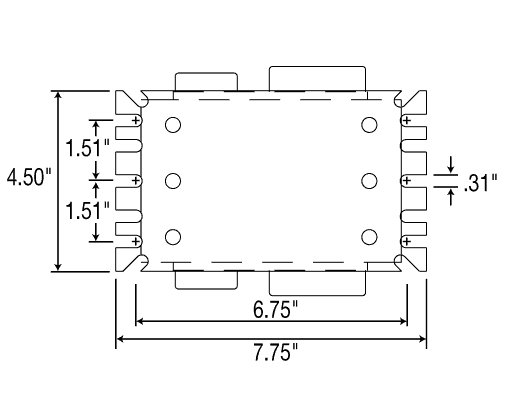
Brackets 

Brackets 


Sheet Metal Table


Gauge size standard:


Thickness Weight Per Area
Gauge in mm lb/ft² kg/m²
0000000.580014.7328.18539.962
000000.516513.1197.28935.587
00000.460011.6846.49231.694
0000.409610.4045.78028.222
000.36489.2665.14825.135
00.32498.2524.58522.386
10.28937.3484.08319.933
20.25766.5433.63517.749
30.22945.8273.23715.806
40.20435.1892.88314.076
50.18194.6202.56712.533
60.16204.1152.28611.162
70.14433.6652.0369.942
80.12853.2641.8138.854
90.11442.9061.6147.882
100.10192.5881.4387.021
110.09072.3041.2806.249
120.08082.0521.1405.567
130.07201.8291.0164.961
140.06411.6280.9054.417
150.05711.4500.8063.934
160.05081.2900.7173.500
170.04531.1510.6393.121
180.04031.0240.5692.777
190.03590.9120.5072.474
200.03200.8130.4522.205
210.02850.7240.4021.964
220.02530.6430.3571.743
230.02260.5740.3191.557
240.02010.5110.2841.385
250.01790.4550.2531.233
260.01590.4040.2241.096
270.01420.3610.2000.978
280.01260.3200.1780.868
290.01130.2870.1590.779
300.01000.2540.1410.689
310.00890.2260.1260.613
320.00800.2030.1130.551
330.00710.1800.1000.489
340.00630.1600.0890.434
350.00560.1420.0790.386
360.00500.1270.0710.345
370.00450.1140.0640.310
380.00400.1020.0560.276
390.00350.0890.0490.241
400.00310.0790.0440.214